Ad Details
-
Ad ID: 31909
-
Added: July 20, 2026
-
Sale Price: $ 1500
-
Condition: Brand New
-
Location: United States
-
State: AK
-
City: Fairbanks
-
Views: 71
Description
There's a moment in every rhythm game fan's life where the screen blurs, the music syncs with your heartbeat, and you realize your fingers are moving faster than your conscious brain can keep up. That moment — the geometry jump — is the soul of an entire genre of gaming, and no game captures it quite like Geometry Dash. If you've ever watched a gameplay video and wondered how on earth someone navigates those spike-lined corridors at breakneck speed, or if you've tried it yourself and felt like your reflexes just aren't cut out for it, this article is for you. Let's break down what makes geometry jumping tick, how to approach it without losing your mind, and why the struggle is genuinely part of the fun.
What Actually Is a Geometry Jump?
At its core, a geometry jump is what happens when a game asks you to move a shape — usually a square, a ball, a ship, or a UFO — through a level where timing is everything. The path is filled with platforms, spikes, portals, orbs, and rings, and the only way forward is to press (or hold and release) your input button at exactly the right moment. Unlike platformers where you have room to explore and experiment, geometry jumping is relentless. There's no pause to strategize, no hidden corners to catch your breath. The level moves at a fixed pace, and you either keep up or you crash.
Geometry Dash takes this concept and polishes it into something almost meditative. Every obstacle is choreographed to a soundtrack — usually electronic music with a strong beat — so the gameplay becomes a kind of physical translation of sound. When the bass drops, you jump. When the synth winds up, you switch gravity. When the rhythm shifts, you prepare for a tight corridor. The game conditions you, over time, to feel the level rather than think your way through it.
Gameplay: The Heart of the Asymmetry
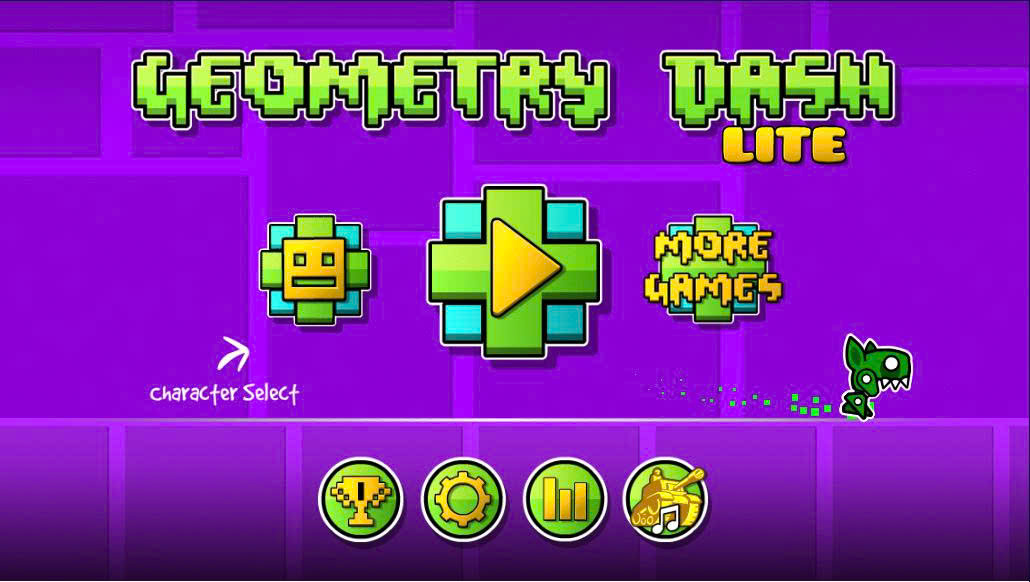
If you launch Geometry Dash for the first time, the experience can feel shockingly simple. One button. One action. That's your entire toolkit. You can tap to jump, or you can hold to fly (in certain game modes). That's it. No attack combos, no inventory, no skill tree. So why is it so hard?
The answer lies in how the game layers complexity. As you progress through the official levels — Stereo Madness, Back on Track, Polargeist, and onward — the game teaches you a new lesson each time. Early levels are generous with landing space and forgiving with timing windows. But by the time you hit Clutterfunk or Theory of Everything, the level design becomes a gauntlet of precision demands. You'll encounter:
- Gravity portals that flip your character upside down mid-flight
- Speed changes that accelerate or decelerate the entire level
- Mini and wave portals that shrink your hitbox or change the control scheme entirely
- Orbs and rings that activate only when you tap near them, requiring pixel-perfect positioning
Each of these mechanics forces you to recalibrate your timing. What worked in Stereo Madness will get you killed in Electroman Adventures. The game doesn't just test your reflexes — it tests your ability to relearn your reflexes on the fly.
One of the most beautiful aspects of geometry jumping is the trial-and-error feedback loop. You crash. You restart. The music starts again. You crash a little further this time. You restart. Eventually, you're not playing a level — you're practicing a choreographed routine that your hands are memorizing. This is why experienced players can close their eyes and still clear sections. Muscle memory, not conscious thought, becomes the driver.
Tips to Survive and Thrive
If you're new to Geometry Dash or geometry jump games in general, here are some practical pointers that go beyond the usual "just practice" advice.
Play with sound on. This cannot be overstated. The level is built around the music. If you mute the game, you're flying blind — literally. The visual cues are designed to sync with the audio, so turning off the sound strips away half the information your brain needs to time jumps correctly.
Use practice mode. You don't need to suffer through the full level every time. Activate practice mode and place checkpoints at sections you find tricky. Repeat those sections in isolation until they feel natural. This is how speedrunners learn levels that take minutes to complete — they break them down into seconds.
Learn to hold and release. Many beginners think geometry jumping is all about tapping. In reality, holding the button for variable durations is just as important. The ship and wave modes require gentle, sustained pressure — too short and you drop, too long and you crash into the ceiling. Get comfortable with micro-adjustments.
Don't chase completion. This sounds counterintuitive, but chasing 100% completion right away will burn you out. Instead, aim for progress. Clear 10% of a level, then 20%, then 30%. Celebrate small milestones. Geometry jumping is a marathon sport disguised as a sprint.
Try user-created levels. The Geometry Dash community has built millions of levels, ranging from beginner-friendly to impossibly difficult. Searching for "easy demon" or "auto" levels can give you a different flavor of gameplay without the frustration curve of the official roster. You'll also discover creative takes on the geometry jump formula that official levels never explore.
Record your gameplay. Watching your own replays can reveal habits you didn't notice — like a tendency to tap late on blue orbs, or holding the button too long during ship sections. Seeing your mistakes from an outside perspective is one of the fastest ways to improve.
Why It's Worth the Frustration
Let's address the elephant in the room: geometry jumping can be brutally frustrating. You will crash at 97% progress more times than you can count. You will close the game in exasperation and swear you're done. And then, hours later, you'll open it again. Why?
Because those rare moments when everything clicks — when your tapping aligns perfectly with the beat, when you clear a section you've been stuck on for days, when you finally see the victory screen — are genuinely euphoric. The game earns your victories. Nothing is handed to you. Every completed level is proof that you persisted through something that felt impossible, and that feeling transfers into real life more than you'd expect.
The geometry jump, at its finest, is a conversation between you, the music, and the level designer. It demands focus, patience, and a willingness to fail beautifully. If you can embrace those three things, then a game like Geometry Dash isn't just a distraction — it's a practice in how to learn anything difficult, one small jump at a time.
Whether you're here for the music, the challenge, or just to see what the hype is about, remember: every player you've watched breeze through a level started exactly where you are. They crashed. They restarted. And eventually, they flew.